
|
Combined Models | 
|
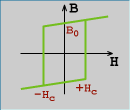
Example 1: Hysteresis
STATE VARIABLE
DISCRETE
Polarization (INT) := +1
DEPENDENT VARIABLE
CONTINUOUS B(REAL)
SENSOR VARIABLE
CONTINUOUS H (REAL)
WHENEVER H > Hc
DO
Polarization := +1;
END
WHENEVER
WHENEVER
H < Hc AND Polarization = +1
DO
Polarization := -1;
END
B := Polarization * B0 + s*H;
B := Polarization * B0 + s*H;
| 1 | 1 |
Beispiel 2: Sawtooth Generator
Discrete and continuous state transitions can take place for the same variable.
DIFFERENTIAL EQUATION
X' := c;
END
WHENEVER X > a
DO
WHENEVER X > a
DO
X^ := -a;
END
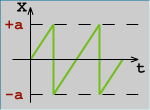
The course of the signal x increases linearally with slope c. Once the upper limit a is reached, the value of the variable x jumps to -a. This consumes a time increment dt, but no real time t.
The integration of the differential equation is interrupted just after the condition is true that triggers the event.
